PodcastsBusinessThe Vault Unlocked

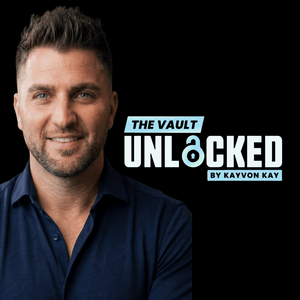
The Vault Unlocked

Kayvon Kay
The Vault Unlocked
Latest episode

41 episodes

  • The Vault Unlocked

    Health Optimization for Business Owners: Why Biohacking Doesn't Work (And What Does)

    06/10/2026 | 1h 2 mins.
    Most people optimizing their health are spending the most and changing the least.
    They have the drawers full of nootropics, the cold plunge, the red light panel, the vagus nerve device that stopped working two weeks in. They have the data. They have the gadgets. And they still wake up feeling like garbage.
    This episode explains why.
    Kayvon sits down with John Goldman, founder and CEO of Rebel Health Alliance, who spent decades as an athlete and entrepreneur and still woke up at 46 prediabetic, with high blood pressure, fatty liver disease, and inflammation through the roof. He had no idea. The diagnostics put it in black and white, and what he did next became the basis for a company built on a single uncomfortable idea: the entire health optimization industry is selling people the wrong 5 percent.
    John breaks down where health optimization actually came from, why the traditional healthcare system was never built to make you healthy, and how a 1930s policy decision quietly split the treatment of disease from the generation of health. He explains why high agency operators keep buying more tests, more wearables, and more supplements while missing the boring fundamentals that drive 95 percent of the result. Then he names the one role almost nobody in your health actually plays: the fiduciary who has no product to sell you.
    This is also a conversation about money. The hundreds of billions spent treating preventable disease. The insurance math that has quietly changed underneath everyone. And why the new class of metabolic drugs is about to become the most widely used pharmaceutical in American history.
    This episode is for founders, operators, and executives who already know their business is only as optimized as they are. If you run hard, carry the weight, and have started to feel the ceiling in your own body, this is the diagnostic you have been avoiding. If you are looking for another supplement stack to buy, this is not for you.
    The conversation moves through what health optimization really means for people running businesses under pressure, why cardio respiratory fitness outranks nearly every other intervention for long term performance, how resistance training and sleep quietly outperform the expensive trends, and what it actually takes to build a system around your health instead of a shelf full of abandoned devices. It is a clear look at energy, longevity, and the link between physical condition and the capacity to lead, scale, and make sharp decisions.
    Topics covered:
    Why your business is only as optimized as you are

    The diagnostics most doctors never order, and why

    The Flexner Report and the system that splits health from treatment

    The "health fiduciary" and why no one in your current setup plays that role

    The boring fundamentals that drive 95 percent of results

    Where red light, cold plunge, peptides, and nootropics actually fit

    VO2 max, fat free mass index, and the metrics that predict longevity

    The metabolic drug wave and what it means for the economy and the country

    Looking to dive deeper into these conversations and connect with our host and guest?
    Follow John Goldman: 
    Instagram
    LinkedIn
    X
    Learn more about Rebel Health Alliance
    Follow Kayvon:
    Instagram
    Facebook
    LinkedIn
    TikTok
     
     
    Want to go deeper with Kayvon?
    Subscribe to the newsletter
    Book a discovery call
    Get your Revenue Engine Scorecard™️
    Hire the right salespeople
  • The Vault Unlocked

    Why Playing It Safe Is the Riskiest Thing a Founder Can Do (The Jeff Bezos Principle Nobody Applies)

    06/03/2026 | 42 mins.
    Most business owners think risk is the enemy. The man who decoded Jeff Bezos found the opposite.
    The instinct to wait, to protect what you have, to move only when the path is certain feels responsible. It is the exact behavior that kills companies slowly enough that no one notices until it is too late.
    This episode names the thing nobody wants to say out loud: caution is not safety. It is a slow-motion decline you mistake for stability.
    Steve Anderson, author of The Bezos Letters, spent his career in one of the most risk-averse industries on earth: insurance. Then he read every shareholder letter Jeff Bezos ever wrote, start to finish, as a single narrative. What he found became a Wall Street Journal and USA Today bestseller translated into 21 languages, and a set of 14 growth principles that explain how Amazon went from burning millions to dominating the planet.
    Kayvon pushes past the surface. They get into what Bezos was actually saying to a board watching the company lose money for over a decade, and what he was not saying. The conversation moves through the principle of unwarranted risk aversion, the discipline of obsessing over customers until friction disappears, and why Amazon wins by making complexity simple while competitors assume that complexity protects them.
    Then it sharpens. Bezos ended every letter the same way: it is always Day One. When an employee asked him what Day Two looked like, his answer was stasis, then irrelevance, then painful decline, then death. That single idea reframes how a founder should think about success itself, because the companies most at risk are usually the ones that already won.
    This is for founders, operators, and executives who are growing but feel stuck below their ceiling. For the people building something real who suspect their own caution is the thing holding it back. If you want motivation, this is the wrong room. If you want the operating logic behind one of the most valuable companies in history, stay.
    The conversation also covers what most business owners get wrong about experimentation, why failure is the price of invention rather than the absence of it, how customer obsession can quietly turn into pressure that costs you elsewhere, and where AI fits into the same pattern Bezos identified years before it became obvious. Eager adoption of external trends was on his short list for surviving Day Two long before machine learning was a headline.
    Topics Covered:
    Why unwarranted risk aversion is the real threat to a growing business

    How reading every Bezos letter revealed 14 repeatable growth principles

    The test, build, accelerate, scale framework and where most founders stall

    Customer obsession as a system for removing friction, not a slogan

    The hidden cost of customer obsession on the people doing the work

    Making complexity simple as a competitive weapon

    The Day One mindset and why Day Two means decline

    Where AI sits inside Bezos's logic of adopting external trends early

    Looking to dive deeper into these conversations and connect with our host and guest?
    Follow Steve Anderson: 
    Instagram
    Facebook
    LinkedIn
    X
    Buy The Bezos Letters on Amazon 
    Learn More
    Follow Kayvon:
    Instagram
    Facebook
    LinkedIn
    TikTok
     
     
    Want to go deeper with Kayvon?
    Subscribe to the newsletter
    Book a discovery call
    Get your Revenue Engine Scorecard™️
    Hire the right salespeople
  • The Vault Unlocked

    How to Build Real Wealth From Nothing (The System a $600M Manager Actually Uses)

    05/27/2026 | 38 mins.
    Most people are not investors. They are spenders with investment accounts. They make decent money, move some of it around, and wonder why the number never compounds into anything real. The diagnosis is not the portfolio. It is the decision that came before it. This conversation breaks that down.
    Wes Rowlands from Atikan Wealth Partners grew up poor, moved to California with nothing, slept on a floor for years, and built his way to managing nearly $600 million in assets. He did not get there by finding the right tip or timing the market. He built a system. A framework for how wealth actually gets constructed, layer by layer, decision by decision, over decades.
    What separates this conversation from the standard finance content you have already heard is that Wes does not talk about tactics. He talks about the order of operations. Most people jump to investing before they have solved for earning. Most savers think they are being disciplined when they are actually falling behind inflation. Most owners have no idea whether their assets are productive or just speculative. These are not small distinctions. They are the difference between building generational wealth and running in place.
    Wes introduces a decision tree that every financial leader needs to run before a single dollar moves: Owner, Lender, Spender, or Saver. Then he breaks down the difference between speculative assets and productive assets, why one is a hard game almost nobody wins, and why the other is how serious wealth has always been built. He also covers financial escape velocity, the moat money concept, and why the biggest wealth problem most people have is not what they think it is.
    Kayvon and Wes also get into what it actually costs to build something real. The years. The floor sleeping. The 24-cent meals. The patience required to stay in the game long enough for the compounding to matter.
    This episode is for founders, operators, and business owners who are already generating income and want to understand how to make it compound. It is not for people looking for shortcuts or stock tips. If you are serious about personal finance as a leadership discipline, not a hobby, this is the conversation.
    Topics Covered
    The wealth building order of operations: make it, save it, grow it

    Owner vs Lender vs Spender vs Saver: the first decision every financial leader must make

    Speculative assets vs productive assets and why the distinction determines your outcome

    Financial escape velocity: what the number is and how to calculate it for your life

    Moat money: the short and medium term capital buffer that protects long-term assets

    Why saving alone will not build wealth and how inflation quietly destroys purchasing power

    Generational wealth: how it gets built, how it survives, and how it gets destroyed

    The 2% principle: why most of your success comes from factors outside your control and what you owe that fact

    What going all in actually looks like when there is no safety net

    Why most people misdiagnose their wealth problem as an investment problem


    Looking to dive deeper into these conversations and connect with our host and guest?
    Follow Wes Rowlands:
    Instagram
    LinkedIn
    YouTube
    Learn more on Wes' Website
    Learn more about Atikan Wealth Partners 
    Follow Kayvon:

    Instagram
    Facebook
    LinkedIn
    TikTok
     
     
    Want to go deeper with Kayvon?

    Subscribe to the newsletter
    Book a discovery call
    Get your Revenue Engine Scorecard™️
    Hire the right salespeople

  • The Vault Unlocked

    Why Preparation Is the Most Undervalued Skill in Sales Negotiation (And How to Use It)

    05/20/2026 | 34 mins.
    Most deals don't die because the price was wrong. They die because someone walked into the room unprepared, assumed they understood what the other side wanted, and spent the entire negotiation reacting instead of leading. That is not a price problem. That is a systems problem.
    Walker Thrash, from Vertikal Collaborative, has structured public-private real estate deals across multiple states, navigated city councils, state agencies, and private capital partners simultaneously, and built a firm that puts its own money on the line in nearly every project it touches. He does not negotiate from theory. He negotiates from skin in the game.
    In this conversation, Walker breaks down exactly how the most sophisticated real estate operators approach high-stakes negotiation from the first meeting to close. The framework is not complicated. It is just rarely executed. Preparation unlocks authority. Authority unlocks questions. Questions surface the real deal. And the real deal is almost never about price.
    They talk through the mechanics of how preparation shifts power in any room, why the person asking the most questions holds the most leverage, how to identify the true authority at the table and speak directly to it, and why making your math objective eliminates the tension that kills deals before they start. They also get into the counterintuitive move that separates good negotiators from great ones: asking the other side to help you solve the problem. When the opposing party becomes a thought partner, the deal moves faster and closes tighter.
    This episode is for founders, operators, developers, and executives who negotiate at a level where the stakes are real and the margin for error is not. If you are still treating negotiation as a conversation about price, you are starting from the wrong place.
    Real estate deal-making, public-private development, commercial negotiation strategy, and high-stakes business leadership all depend on the same foundation: knowing what the other side actually needs before you say a word about what you want. That principle applies whether the deal is a $5M land acquisition or a $500M mixed-use development.
    Topics covered:
    Why preparation is the most undervalued skill in real estate negotiation

    How asking questions outperforms presenting solutions

    Identifying and speaking from authority in any negotiation room

    Why price is rarely the real issue in a failed deal

    Making math objective to remove tension and accelerate close

    The "thought partner" move that gets deals off the ground faster

    What kills deals before they ever reach the table

    Looking to dive deeper into these conversations and connect with our host and guest?
    Follow Walker:
     
    LinkedIn

    Website

    Buy Walker's book
    Follow Kayvon:

    Instagram

    Facebook

    LinkedIn

    TikTok
     
     
    Want to go deeper with Kayvon?

    Subscribe to the newsletter

    Book a discovery call

    Get your Revenue Engine Scorecard™️

    Hire the right salespeople

  • The Vault Unlocked

    How to Get Your First SaaS Customers Without a Product (The Customer Development Framework Nobody Teaches)

    05/13/2026 | 37 mins.
    Most founders are building the wrong thing.
    Not because they lack skill. Not because the market isn't there. Because they skipped the one conversation that tells you whether any of it is worth building in the first place.
    By the time most SaaS founders realize they've been validating their idea instead of the market's problem, they've already burned 18 months and a team's worth of goodwill. Collin Stewart lived that. He built anyway. Nobody bought. And what came out the other side became one of the most repeatable zero-to-revenue frameworks operating in SaaS today.
    This episode is that framework, unfiltered.
    Collin went from 18 months of zero traction on a CRM nobody asked for, to tripling monthly revenue in a single month, fully manual, before a single line of new code was written. He didn't pivot because of a blog post or a course. He pivoted because a mentor told him the truth, and he finally stopped arguing with his customers long enough to hear it.
    What changed wasn't the product. It was the sequence. Talk first. Build second. Sell before you ship.
    This conversation is for founders who are early, moving fast, and quietly unsure whether they're building toward something real or just building. It is also for operators who've hit a ceiling and suspect the problem starts at the top of the funnel, before the pitch, before the demo, before any of it.
    Collin breaks down how to identify the right customer, how to conduct a development conversation that actually surfaces pain instead of validating your assumptions, and how to move a prospect from "can I pick your brain" to paying customer across a structured sequence of meetings. He also covers why referral asks at the end of every conversation function as a self-healing list, why most cold outreach fails at the signal level, not the copy level, and what it actually looks like to run a pilot before committing engineering resources.
    This is the go-to-market strategy conversation most startup accelerators skip. Customer discovery, early revenue generation, SaaS sales without a product, zero to one frameworks, and founder-led sales systems are all covered in direct, practical terms, drawn from a decade of hands-on zero-to-revenue work.
    Topics covered:
    Why showing customers what you built is not customer validation

    The customer development funnel and how to move prospects through it

    How to run a manual pilot before building anything

    The Wizard of Oz method for generating real revenue signals

    Why referral asks function as a list-building system

    Relationship-first prospecting vs. cold outreach that dies on delivery

    What AI has changed about the speed of the zero-to-one window

    Looking to dive deeper into these conversations and connect with our host and guest?
    Follow Collin Stewart:
     
    LinkedIn

    The Terrifying Art of Finding Customers book

    Predictable Revenue website

    Founders Edition newsletter

    Collin's Slidedeck 
    Follow Kayvon:

    Instagram

    Facebook

    LinkedIn

    TikTok
     
     
    Want to go deeper with Kayvon?

    Subscribe to the newsletter

    Book a discovery call

    Get your Revenue Engine Scorecard™️

    Hire the right salespeople
More Business podcasts
About The Vault Unlocked
Vault Unlocked is for founders who don't want to learn the hard way. If you're building something real and you care about growing revenue faster, cleaner, and with fewer blind spots, this podcast is your unfair advantage. Hosted by Kayvon Kay, Vault Unlocked brings elite founders and operators into conversations they normally keep private. Not the public story. The real one. The fumbles that cost them millions. The decision they almost didn't make. The strategy they only understood after it finally worked. Every episode is built around one question founders actually care about: "What do you know now that would have saved you time, money, and pain if you learned it earlier?" Kayvon goes deep on purpose. The guests don't hide. Because surface-level answers don't grow companies. This is where you learn what not to do, what actually moved the needle, and how the best founders think when things are on the line. No motivation. No recycled playbooks. Just inside access to hard-earned lessons that help you grow faster by learning from other people's mistakes, missteps, and breakthroughs. If you want to shortcut the learning curve without gambling your own business, Vault Unlocked is for you. Listen like a founder who plans to win.
Podcast website

Listen to The Vault Unlocked, Digital Social Hour and many other podcasts from around the world with the radio.net app

Get the free radio.net app

  • Stations and podcasts to bookmark
  • Stream via Wi-Fi or Bluetooth
  • Supports Carplay & Android Auto
  • Many other app features
The Vault Unlocked: Podcasts in Family